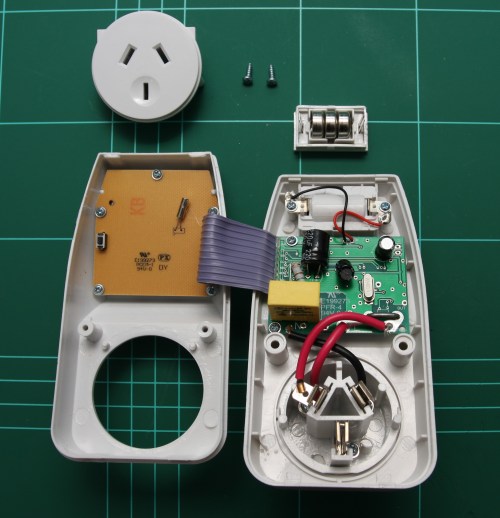
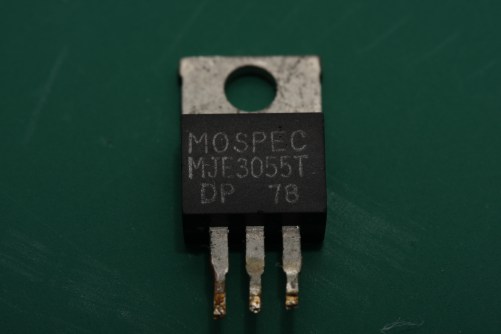
Following on from the recent teardown of a cheap energy meter, I thought there might be some potential to hack this device. Well the EOUT “pulse output” pin shows some promise. The chip’s datasheet says that the EOUT pin outputs a pulse for each unit of energy the meter measures. Additionally, this function is enabled by default.
Since this is enabled, by default, I made some mods to the case and soldered 3x wires directly to the chip.
Wires soldered directly to chip pin 21 (EOUT) and power supply (decoupling capacitor)
A friend of mine recently asked me if I knew that there are two package types for humble TO220 devices. I didn’t understand what he meant. He then asked if I had heard of single gauge and dual gauge TO220 packages. Nope still no idea. Finally, he asked if I had seen TO220 voltage regulators such as a 78L05 device with a thin heatsink?
Yes, I had seen these before, in fact I have a couple. I hadn’t really paid a lot of attention to the first time I had seen one of these components with a thin heatsink. I thought that it was perhaps a counterfeit device. That is not the case (excuse the pun). A thinner heatsink is a type of TO220 package.
Below are two TO220 devices, a 7812 12V regulator manufactured by On Semiconductor and a TIP31 NPN transistor from ST Microelectronics. A quick glance and their shape is instantly recognisable.
TO220 packages for a 7812 12V regulator and a TIP31 NPN transistor.
Honestly, each board that was made was a fail. Electrically, they all worked correctly. The failure was during the manufacturing stage – reflow soldering very small SMD components.
Just as an aside, Adafruit Neopixel devices use WS2812B LEDs which have some very strict timing requirements – this can be problematic for some devices that use software interrupts. Whereas, the APA102C LED is a chip that does not suffer from strict timing.
Each small PCB, contains 9x APA102C SMD LEDs and 8x 0.1uF 0603 ceramic capacitors for power supply decoupling. Each APA102C LED is the large white square with white circle. Between the rows of the APA102C LEDs are the SMD pads for the 0603 size capacitors.
My Logitech Performance MX wireless mouse recently had a failed left click button. However, this was easily repaired with a switch from an obsolete mouse.
Repairing the switch is a straightforward task with all the details compiled into a tutorial.
Old seven segment displays definitely have a cool factor. These TIL302 displays from Texas Instruments are no exception.
Five of these displays were picked up cheap on eBay recently. I plan to use them in an upcoming project that requires a display that is a little more special than a standard seven segment display. Continue reading →