Honestly, each board that was made was a fail. Electrically, they all worked correctly. The failure was during the manufacturing stage – reflow soldering very small SMD components.
Just as an aside, Adafruit Neopixel devices use WS2812B LEDs which have some very strict timing requirements – this can be problematic for some devices that use software interrupts. Whereas, the APA102C LED is a chip that does not suffer from strict timing.
Each small PCB, contains 9x APA102C SMD LEDs and 8x 0.1uF 0603 ceramic capacitors for power supply decoupling. Each APA102C LED is the large white square with white circle. Between the rows of the APA102C LEDs are the SMD pads for the 0603 size capacitors.
If you are using Autodesk 123D Design to create your models, it will generate your STL files in ASCII STL format. XYZware is slow to load large ASCII STL files. Slicing an ASCII STL file can take a very long time too.
XYZware black screen of death when loading large STL files
Fortunately, there is a solution. Saving your STL files in a Binary format will result in improved load and slicing times.
Converting your ASCII STL files to Binary is very simple. This simple guide shows you how.
My Logitech Performance MX wireless mouse recently had a failed left click button. However, this was easily repaired with a switch from an obsolete mouse.
Repairing the switch is a straightforward task with all the details compiled into a tutorial.
Two different filament guides for Ninjaflex have been trialed with differing success.
One made from heatshrink was promising initially but has failed to be robust. The second, using a 3D printed component from Thingiverse has increased print time but is difficult to install.
Old seven segment displays definitely have a cool factor. These TIL302 displays from Texas Instruments are no exception.
Five of these displays were picked up cheap on eBay recently. I plan to use them in an upcoming project that requires a display that is a little more special than a standard seven segment display. Continue reading →
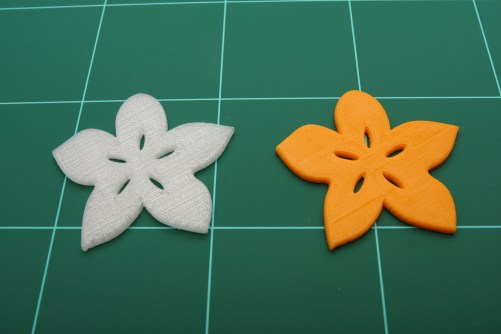
A quick update. Following on from the ongoing progress with using Ninjaflex (TPE) with a Da Vinci printer, I’ve managed to successfully print some generic clear PLA filament.
PLA on the left. ABS on the right.
An advantage of PLA compared to ABS is PLA is available in transparent colours. The smell of heated PLA is not as strong as ABS. However, the mechanical strength of the material is lower than ABS.





 SteelCity Electronics